





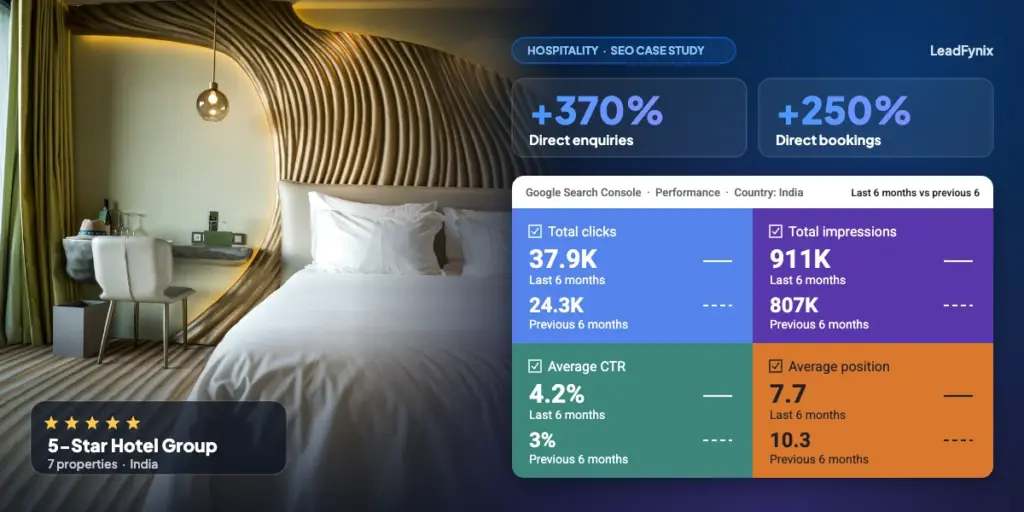
A 5-star hotel group in India wanted more guests to find and book its properties directly through Google. LeadFynix ran a complete SEO programme across seven of the group’s properties, covering technical SEO, on-page and content optimisation, local SEO and link building. In six months, direct enquiries grew by 370% and direct bookings by 250% compared with the previous six months.
Key Results in 6 Months
370%
Increase in direct enquiries
250%
Increase in direct bookings
+56%
Growth in organic search clicks
10.3 → 7.7
Average Google position
Client Overview
| Industry | Hospitality (5-star hotels) |
|---|---|
| Client | A 5-star hotel group in India (name withheld for confidentiality) |
| Properties in scope | 7 properties across India |
| Property types | City business hotels, leisure resorts and heritage properties |
| Services | SEO: technical SEO, on-page and content, local SEO, links and digital PR |
| Timeframe | 6 months, compared with the previous 6 months |
The Goal
The hotel group operates many properties across India. The brief was to grow direct enquiries and direct bookings from Google search for seven priority properties, so that more guests discovered each hotel, compared rooms and experiences on the hotel’s own website, and enquired or booked there.
Why Hotel SEO Is Hard for a Multi-Property Group
- Many properties, one brand: seven hotels in different cities have to be found for their own location, not just for the brand name.
- Crowded search results: hotel searches are dominated by booking platforms, travel aggregators and maps listings, leaving little room for the hotel’s own website.
- Different guests, different intent: business travellers, holidaymakers, couples and wedding or event planners all search in different ways and need different pages.
- Local visibility decides the stay: for most travel searches, guests choose from the map results and reviews before they ever visit a website.
LeadFynix’s Solution
We treated SEO as one connected system across all seven properties, rather than as separate fixes, built on four pillars.
1. Technical SEO and Speed
A full site audit, crawl and indexing fixes, mobile improvements and Core Web Vitals work to make every property page fast and easy for Google to understand, plus hotel structured data so search engines can read each property’s details.
2. On-Page Optimisation and Content
Property pages were optimised around how guests actually search: rooms and suites, dining, spa, and weddings and events. New content was added to answer the questions travellers ask before booking.
3. Local SEO and Google Business Profiles
Each property’s Google Business Profile, map presence, reviews and local citations were strengthened, so the hotels appear prominently when travellers search in and around their cities.
4. Links and Digital PR
High-quality backlinks, travel and PR features and relevant directory listings built the authority each property needed to outrank competing listings.
Our Strategy, Step by Step
Step 1: Audit and Priorities
We audited the website and the search presence of all seven properties to find the technical issues, ranking gaps and quick wins with the biggest impact on enquiries.
Step 2: Technical Foundation
We fixed crawling, indexing, speed and mobile issues and added hotel structured data, so every property page could compete.
Step 3: Property-Level Page Optimisation
We mapped search intent for each property type (business, leisure and heritage) and optimised room, dining, spa and event pages to match it.
Step 4: Local SEO for All Seven Properties
We optimised Google Business Profiles, map listings, reviews and citations for each hotel’s location.
Step 5: Content, Links and PR
We published helpful content for travellers and earned links and features from travel and hospitality sources.
Step 6: Measure and Refine
We tracked clicks, rankings, enquiries and bookings every month and refined pages based on real performance data.
Campaign Channels Used
- Technical SEO, Core Web Vitals and hotel structured data
- On-page SEO and content for rooms, dining, spa, weddings and events
- Local SEO and Google Business Profile optimisation for 7 properties
- Link building, digital PR and directory listings
Results After 6 Months
Direct Enquiries: +370%
Direct enquiries through the hotel’s website grew by 370% compared with the previous six months, giving the sales and reservations teams far more guests to convert.
Direct Bookings: +250%
Direct bookings grew by 250% over the same period, so more of the group’s revenue now comes through its own website.
Organic Search Growth
Clicks from Google search grew from 24,300 to 37,900, a 56% increase, while search impressions rose from 807,000 to 911,000 (+13%). The properties were not only seen more often; far more searchers chose to click.
Stronger Rankings
The average Google position improved from 10.3 to 7.7, moving the hotels’ pages from the edge of pages one and two into solid page-one visibility.
Higher Click-Through Rate
Average click-through rate rose from 3.0% to 4.2%, showing that better rankings and better-matched pages made the hotel’s own listings more attractive than competing results.
Search figures: Google Search Console, searches from India, last 6 months compared with the previous 6 months. Enquiry and booking figures: the client’s direct website enquiries and bookings for the same periods.
Key Takeaways for Hotels
- Direct bookings are an SEO outcome: when a hotel’s own pages rank for the right searches, guests can book directly with the hotel.
- Every property needs its own visibility: multi-property groups win by optimising each hotel for its own location and guest type.
- Local SEO matters as much as the website: Google Business Profiles and reviews often decide which hotel a traveller shortlists.
- Measure enquiries and bookings, not just traffic: rankings and clicks matter because they lead to real guests.
Hotel SEO: Frequently Asked Questions
How long does hotel SEO take to show results?
It depends on the website’s starting point and competition. In this case study, the hotel group saw a 370% increase in direct enquiries within six months. Technical fixes and local SEO often show early gains, while content and authority keep building over time.
Can SEO increase direct hotel bookings?
Yes. When a hotel’s own pages rank well for the searches guests make, more travellers reach the hotel’s website and book directly. Here, direct bookings grew by 250% in six months.
Does each hotel property need its own SEO?
For multi-property groups, yes. Each property should have well-optimised pages, its own Google Business Profile and local signals for its location, so it can rank where its guests are searching.
What does local SEO mean for a hotel?
Local SEO helps a hotel appear in map results and local searches. It covers the Google Business Profile, reviews, accurate business details across directories and location-focused content.
Want More Direct Bookings for Your Hotel?
LeadFynix helps hotels, resorts and hospitality groups grow direct enquiries and bookings with SEO built around how guests search. Tell us about your properties and we will show you where the biggest opportunities are.
Discuss your hotel’s growth with LeadFynix →
Explore our SEO services, see how we work with businesses in India, or read more client case studies.