Most marketing funnels are built with one type of buyer in mind, and that’s fine until you try to use the same funnel on the other type. That’s usually when things stop working, and nobody can quite figure out why.
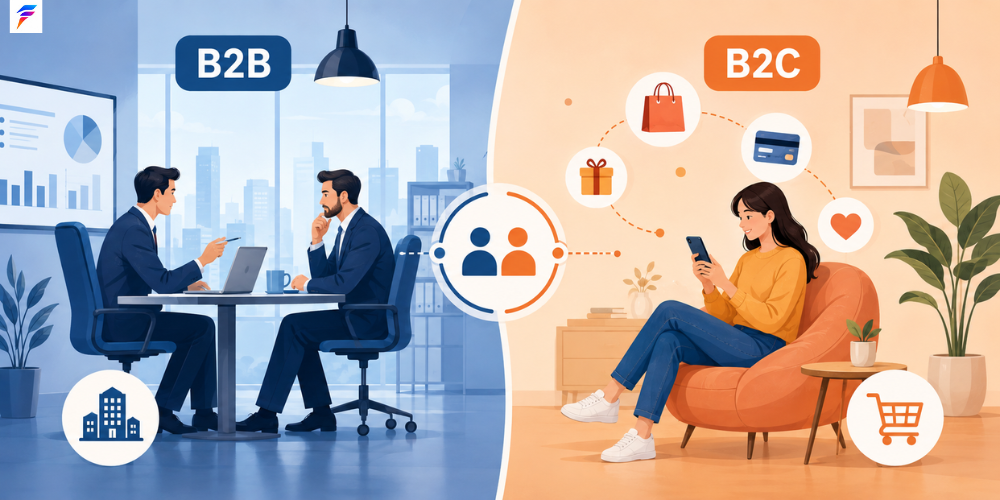
The reason comes down to this: B2B and B2C buyers think differently, decide on different timelines, and respond to different kinds of messaging. A business buyer might spend weeks or months comparing options while several other people weigh in on the decision. A consumer might make a decision within minutes while scrolling through their phone. Treat those two the same way, and even a well-funded campaign can struggle to deliver results.
So here’s where B2B vs B2C differs — and what that means for how you should be generating and nurturing leads in each.
Who Makes the Buying Decision
In B2C, it’s usually just one person. Someone scrolls past a pair of running shoes on Instagram, likes what they see, and buys them ten minutes later. Nobody else needs to sign off. Friends and reviews might sway the decision a bit, but there’s no approval chain to work through.
B2B rarely works that way. A single purchase might pass through an end-user, a department head, someone in finance, and sometimes legal or procurement too. Gartner’s research on B2B highlights the complexity of B2B buying groups, where different stakeholders can have different goals and needs throughout the buying process. So your marketing isn’t really talking to a person — it’s trying to win over a small committee, several of whom haven’t even met each other’s objections yet.
That’s the first real fault line in B2B vs B2C: consumer marketing has to persuade one person, while B2B marketing has to build agreement across a group that might not even agree with itself at first.
How the Buying Journey Differs
A B2C purchase can be over in under a minute. See an ad, click, check out — done, often without leaving the app. Marketers here are chasing speed and whatever emotional trigger gets someone to tap “buy” before they scroll past.
B2B stretches that timeline out to weeks or months, and much of the buying journey can happen before a salesperson gets involved. Gartner’s research shows that B2B buyers increasingly use digital channels to research and evaluate solutions, with 75% preferring a rep-free sales experience. By the time a rep actually gets a call, the buyer usually already has a shortlist in their head.
That’s part of why B2B lead generation strategies rely so heavily on educational content and case studies — stuff that does the convincing before a prospect ever talks to sales. B2C is different. Those strategies focus on grabbing attention fast and making it easy to buy right away, because that window doesn’t stay open long.
Days vs. Months: Why the Sales Cycle Changes Everything
Sales cycle length isn’t a minor detail — it basically dictates how you have to build your whole funnel, and it’s one of the more practical ways B2B vs B2C shows up in real numbers.
A B2C sales funnel is short and mostly a straight line: see it, want it, buy it, sometimes all in one sitting. That’s why retargeting ads work so well here. Someone almost buys, wanders off, and a small nudge the next day is often enough to bring them back.
A B2B sales funnel doesn’t move in a straight line at all. Prospects go back and forth between research, internal debate, and evaluation before anyone actually commits. Depending on the industry, that can run anywhere from a few weeks to well over a year for the bigger enterprise deals. That’s exactly why lead nurturing carries so much weight in B2B — a single ad or one good email isn’t usually enough to close a complex B2B deal. What actually gets deals over the line is a steady drip of relevant content and follow-up that keeps you in front of the right people until they’re finally ready to move.
B2B vs B2C: Logic and Emotion
There’s a popular idea that B2C buying is driven by feelings while B2B buying is driven by logic. It sounds tidy, but the reality is more complicated. A joint study by Google, Gartner, and Motista that surveyed thousands of B2B buyers found something almost backwards from what you’d expect — business buyers were more emotionally attached to their vendors than typical consumers are to the brands they love. The average B2C brand had an emotional connection with between 10% and 40% of consumers, while seven of the nine B2B brands studied had emotional connections with more than 50% of their customers.
Emotion doesn’t vanish in B2B — it just shows up differently. B2C buyers are usually chasing desire, identity, or plain instant gratification. B2B buyers are chasing something closer to safety: the fear of picking wrong and having it come back on them at work. Someone buying software for their team isn’t only asking “does this do what I need?” They’re also quietly asking “will I be defending this decision in six months?”
That difference matters when you’re writing anything. Consumer marketing can lean into excitement. B2B marketing has to lean into credibility and lowering risk, usually through testimonials, case studies, and numbers that hold up under scrutiny.
Where You Actually Show Up: Channels and Content
This is where B2B vs B2C stops being theoretical and starts affecting your day-to-day marketing calendar.
B2C tends to live on social media, especially the visual platforms, plus short-form video, influencer partnerships, paid social, and email built around discounts and new arrivals. The content can afford to be fun — entertaining as much as informative.
B2B leans somewhere else entirely — LinkedIn, industry forums and communities, whitepapers, webinars, case studies, and SEO content built around narrow, technical questions people are actually typing into Google at 11pm trying to solve a work problem.
Qualifying and Nurturing Leads Isn’t the Same Job
B2C qualification is often simpler because the buying decision usually involves fewer people and happens faster. Businesses may look at actions such as email sign-ups, product views, cart activity, or previous purchases to identify stronger prospects.
B2B qualification takes real work. Teams often lean on something like BANT — budget, authority, need, timeline — or a scoring model built around job title, company size, and how engaged someone’s actually been. A person who read one blog post gets treated very differently from someone who sat through a demo and asked about pricing.
Nurturing follows the same pattern. B2C lead nurturing is often just a short cart-abandonment sequence over a few days — a couple of emails reminding someone they left something behind. B2B lead nurturing takes a lot longer. It can stretch on for weeks or months, chipping away at objections from different people on the buying committee, until the whole group finally lands on yes together.
What Happens After Someone Buys
In B2C, the sale is often treated as the finish line. Loyalty programs and repeat purchases matter, sure, but the relationship afterward tends to stay light.
In B2B, the sale is closer to a starting point than an ending. Contracts run bigger, onboarding takes real time and effort, and the relationship between vendor and client can stretch on for years through renewals and account management. That’s a big reason B2B companies pour so much into customer success — losing a client isn’t just one lost sale, it’s often a meaningful piece of recurring revenue walking out the door.
Where This Leaves You
Line up B2B vs B2C side by side and the differences aren’t cosmetic — they run through nearly every stage of the funnel. B2C moves fast, speaks to individuals, and leans on emotion in the moment. B2B moves slower, speaks to a group, and earns trust over time rather than demanding it upfront. The lead generation strategies that actually work are the ones built around those realities instead of fighting them — a tactic that crushes it with one audience can completely miss with the other.
The businesses getting real results tend to be the ones that stop treating lead generation as one universal formula and start building around how their actual buyers think, whether that means tightening a B2C sales funnel to catch someone mid-impulse or building out a patient, multi-touch nurture sequence for a B2B sales funnel with a six-month decision cycle behind it. That’s the kind of thinking agencies like LeadFynix bring to the table — matching the strategy to the buyer instead of forcing the buyer to fit a strategy that was never built with them in mind.