

Cost Per Lead vs Cost Per Acquisition: What You Should Actually Be Tracking
Here’s a conversation that plays out in marketing meetings every week: someone points at a dashboard and says “our leads are cheap this month,” and someone else from sales quietly asks why none of them are turning into customers. That gap is usually the first sign a team is looking at cost per lead vs cost per acquisition and only paying attention to one of them.
Most businesses pick a favorite metric without meaning to. Marketing tends to lean on cost per lead because it’s the number they can move the fastest. Sales and finance care more about cost per acquisition, because that’s the number that actually shows up in revenue. Both sides have a point. Both are also missing half the story.
This isn’t a “here’s the definition, good luck” article. The real point is helping you figure out which number to actually trust and when, so you stop pouring more budget into a campaign that looks good on a dashboard but isn’t really paying off.
What Cost Per Lead (CPL) Actually Tells You
Cost per lead is about as simple as marketing math gets.
CPL = Total marketing spend / Number of leads generated
For example: If you spend $5,000 and get 100 leads so your CPL is $50. Simple enough. A lead could be anything, someone filling out a form, booking a call, or asking for a demo, depending on what your business tracks.
But here’s the catch. That $50 number only tells you one thing: how much it cost to get someone’s attention for a moment. It doesn’t tell you if that person was actually interested in buying, or if they just filled out a form to grab a free checklist and never thought about you again.
That’s where a lot of marketing money quietly gets wasted.
What Cost Per Acquisition (CPA) Actually Tells You
CPA looks further down the funnel. It answers a more direct question: how much did it cost to actually win a customer, not just collect their email address.
CPA = Total marketing spend / Number of customers acquired
Take that same $5,000 campaign. If only 10 of those 100 leads ever became paying customers, your real CPA is $500. Not $50. That’s a big jump, and it’s usually the moment a “successful” campaign starts to look a little less impressive.
Here’s the quick thing about CPA . Some ad platforms use it to mean Cost Per Action, and “action” could be pretty much anything, a lead, a form submission, a signup, whatever they’ve set up as a goal. But in everyday marketing talk, when someone says CPA, they usually mean Cost Per Acquisition, the actual cost of landing a paying customer, not just someone who filled out a form.
So before you sit down to compare campaign results or talk ROI with anyone, it’s worth just asking which one they mean.
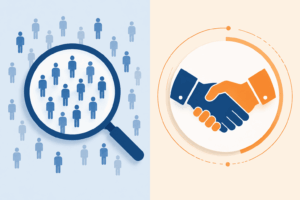
Cost Per Lead vs Cost Per Acquisition: Side by Side
| Aspect | Cost Per Lead (CPL) | Cost Per Acquisition (CPA) |
|---|---|---|
| Measures | Cost to generate interest | Cost to generate a paying customer |
| Funnel stage | Top of funnel | Bottom of funnel |
| Formula | Spend / Leads | Spend / Customers |
| Good for | Testing campaigns and channels quickly | Judging real ROI and profitability |
| Risk if used alone | Looks great while hiding bad lead quality | Slower to calculate on long sales cycles |
| Usually owned by | Marketing | Sales, finance, sometimes marketing too |
Neither one wins. They’re just answering different questions. The problem starts when a team picks one and treats the other as optional.
An Example That Makes This Click
Let’s say you’re running two campaigns for the same offer, same budget.
Campaign A spends $2,000 and pulls in 100 leads at $20 each. Looks great in a Monday morning report. But only 3 of those leads ever buy anything, which puts the real CPA at $667.
Campaign B spends the same $2,000 and only gets 40 leads, at $50 each. On the surface, that looks worse. Except 8 of those 40 actually convert, landing CPA at $250.
Campaign B has the “worse” CPL and a much healthier CPA. If you were only watching lead cost, you’d have poured more budget into Campaign A and wondered later why revenue didn’t follow.
This is really the whole argument for tracking cost per lead vs cost per acquisition together instead of treating one as the scoreboard.
When CPL Deserves Your Attention
CPL isn’t a lesser metric, it just has a specific job. It’s the right number to lean on when:
- You’re testing a brand new channel or audience and want an early read before committing real budget
- Your sales cycle is long (common in B2B, SaaS, healthcare, real estate) and you won’t see acquisitions for weeks
- You’re comparing raw efficiency across ad platforms or creative variations
- You just need a fast signal that something is working before enough data exists to trust a CPA number
CPL buys you speed. You don’t have to wait out a full sales cycle to know if a campaign deserves more attention or should get cut.
When CPA Deserves Your Attention
CPA becomes the priority once you’ve got enough data behind it, especially when:
- You’re deciding whether to pour more budget into a campaign
- You’re comparing channels on actual profitability instead of just lead volume
- Finance is asking about marketing ROI, which, let’s be honest, they always eventually do
- You want to understand what growth is really costing you against customer lifetime value
For context, HubSpot’s research on CPL and CAC benchmarks puts average B2B cost per lead around $84 across channels, with Google Ads averaging closer to $70 and LinkedIn running higher, around $110. Numbers like that only tell half the story though. A $110 LinkedIn lead that closes at a much higher rate can easily beat a $70 Google Ads lead that barely converts.
Where Businesses Get This Wrong
They optimize for CPL and call it a win: Dropping your cost per lead is almost too easy. Loosen the targeting, simplify the offer, cut a form field. CPL drops right away, and so does lead quality, usually at the same time. If nobody’s watching CPA in parallel, this looks like a marketing win right up until sales asks why nothing’s closing.
They compare CPL across channels that don’t attract the same intent: A $30 lead from Facebook and a $30 lead from Google Search are not the same thing. Someone typing “book a consultation” into Google is a different kind of prospect than someone who saw an ad mid-scroll. Comparing CPL across those two without accounting for intent doesn’t really tell you anything useful, they’re not even playing the same game.
They forget sales costs anything at all: CPA calculated purely off marketing spend understates the real cost of a customer if your sales team spends hours qualifying and following up on every lead. That’s where customer acquisition cost, or CAC, comes in, since it usually folds in sales salaries and tools too, not just ad spend.
Nobody agrees on what a “lead” or a “customer” even means: Sounds obvious, but this causes more arguments in meetings than any spreadsheet mistake ever could. Is a lead someone who filled out a form, or someone who actually had a real conversation? Does “acquired” mean they signed a contract, or just made their first purchase? Get everyone agreeing on these definitions before you start arguing about the actual numbers.
They judge a campaign too early. Checking CPA after two weeks on a business with a three-month sales cycle is like stepping on a scale right after a big meal. Give leads time to actually move through the funnel before drawing conclusions.
They treat lead quality like a soft, unmeasurable thing. It isn’t. Semrush’s research on B2B content marketing highlights that attracting quality leads with content remains the top challenge for B2B brands. Every dollar spent chasing lead volume instead of qualified interest often shows up later as a higher CPA.
How Different Channels Push CPL and CPA in Different Directions
Every channel has its own relationship between “how cheap is the lead” and “how likely is it to actually close.” Here’s how that usually plays out.
SEO: Once it’s built up, organic search tends to produce a moderate to low CPL, since there’s no per-click cost attached. The catch is it takes months to get there, and lead quality depends heavily on which keywords you’re actually ranking for. Someone searching “how to choose a provider” is in a very different headspace than someone searching a broad industry term. SEO usually pays off through a lower long-term CPA, even when early numbers look unremarkable while you’re still climbing the rankings.
PPC: PPC gives you speed and control most other channels can’t match. You can be generating leads within days, targeting people already searching for a solution. The tradeoff is cost, and in competitive industries like legal, healthcare, or financial services, cost per click can get brutal fast. CPA on PPC is usually fairly predictable though, since you’re catching people already in decision mode.
LinkedIn: LinkedIn is almost always one of the pricier channels per lead, mostly because you’re paying for precision, job title, industry, company size, that kind of thing. And honestly, that precision is usually worth it in B2B, where a handful of well-matched leads beats a flood of ones that don’t fit. CPA on LinkedIn tends to look better than the sticker price suggests, once you factor in how closely those leads match your ideal customer.
Email marketing: Once you’ve got a list, email is cheap to run, so CPL is usually low. But email works best as a nurture channel, not a first-touch acquisition channel. Its real value shows up in CPA, by moving people who already know you a little closer to a decision, rather than pulling in brand new leads from scratch.
Social media (organic and paid): Organic social usually brings in cheap leads, but lower intent ones, since most people scrolling aren’t exactly thinking about buying anything. Paid social can rack up a lot of volume at a low CPL, but conversion rates tend to lag behind search-based channels, which means CPA can end up higher than those early numbers make it look. It’s a stronger fit for awareness and retargeting than as a channel judged purely on direct response.
| Channel | Typical CPL | Typical Lead Intent | CPA Behavior |
|---|---|---|---|
| SEO | Low to moderate (after it starts ranking) | Medium to high | Improves over time |
| PPC | Moderate to high | High | Fairly predictable |
| High | High (B2B) | Often better than it looks | |
| Very low | Depends on list quality | Best for nurturing, not first touch | |
| Social (paid) | Low to moderate | Low to medium | Can mislead if judged on CPL alone |
So What Should You Actually Be Tracking
If there’s one takeaway here, it’s this: track both, and never look at either one in isolation.
A few things that make this easier in practice:
- Use CPL as your early warning system. It tells you fast whether a campaign or channel is even worth watching further.
- Use CPA as your actual decision-making number. Before scaling budget anywhere, know what it really costs to win a customer through that channel.
- Break both numbers out by channel, not just as one blended figure. A single average CPA hides which channels are carrying the team and which ones are dragging it down.
- Set your acceptable CPA based on what a customer is actually worth to you over time, not on what feels comfortable in the moment. A $400 CPA can be a fantastic deal if that customer’s lifetime value is $2,000. A $50 CPL means nothing without that context.
- Review these numbers on a schedule that matches your sales cycle. Weekly works for fast-moving B2C. Monthly or quarterly makes more sense for longer B2B or healthcare cycles, where two weeks of data won’t tell you much.
A Quick Word on CAC
You’ll often hear CAC mentioned right alongside CPA, and it’s worth knowing what actually separates the two. CPA is typically a campaign-level number based on marketing spend alone. CAC is the wider version, usually folding in sales salaries, tools, and overhead on top of marketing costs. HubSpot’s customer acquisition cost research points to a healthy LTV to CAC ratio of roughly 3 to 1 as a general benchmark, meaning a customer should generate at least three times what it cost to acquire them. If your CPA is already sitting close to that line, your full CAC, once sales costs are added in, could be tighter than you’d like.
You don’t need to remember every acronym here. What matters is your team agrees on what each number includes, so nobody’s comparing a narrow marketing-only figure against a company-wide one and drawing the wrong conclusion from it.
Conclusion
Once you look closely, the whole cost per lead vs cost per acquisition debate stops being much of a debate. CPL tells you what attention costs. CPA tells you what that attention was actually worth. A team that only watches CPL is flying with half the instruments switched off. A team that only watches CPA usually finds out too late that a campaign was struggling. The businesses that actually grow, and keep growing, are the ones watching both numbers side by side. They know what moves each one, and they make calls based on what a customer is really worth, not just what a lead looks like sitting on a dashboard.
Getting cost per lead vs cost per acquisition right isn’t about crowning a winner between the two. It’s about using both together to make smarter calls with your budget, campaign by campaign, channel by channel.
If you’d rather not sort through this on your own, LeadFynix can walk you through what properly tracked, multi-channel lead generation actually looks like for your industry, measured by real qualified opportunities instead of cheap form fills. Get in touch and we’ll go through your numbers together.